Technical Summary & Field Standards
Pavers sit on a 1 inch layer of bedding sand over a compacted gravel base. How much sand and base to order for a patio, by size, in yards, tons and bags.
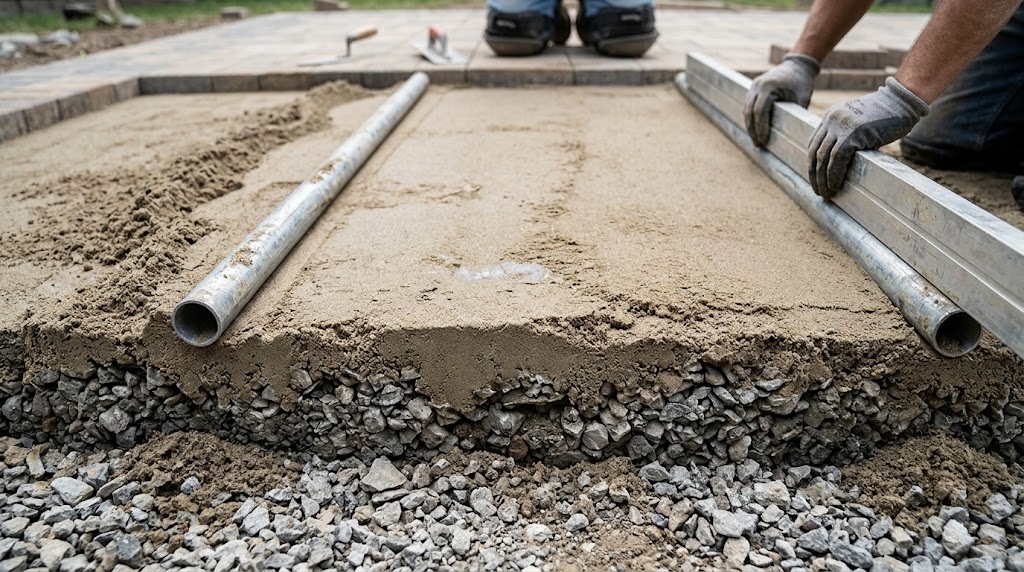
Pavers are laid on a screeded layer of coarse bedding sand about 1 inch thick, which works out to about 0.31 cubic yards (roughly 8.3 cubic feet) per 100 sq ft. The sand sits on a thicker layer of compacted crushed stone base, and that base is where most of the material and work goes.
Sand and base by patio size
1 in of bedding sand, plus 4 in of compacted crusher run base (with 15% added for compaction):
| Patio | Sq ft | Sand (yd³) | Sand (tons) | Sand (0.5 cu ft bags) | Base (yd³) | Base (tons) |
|---|---|---|---|---|---|---|
| 10 × 10 ft | 100 | 0.31 | 0.42 | 17 | 1.42 | 2.13 |
| 12 × 12 ft | 144 | 0.44 | 0.6 | 24 | 2.04 | 3.07 |
| 12 × 16 ft | 192 | 0.59 | 0.8 | 32 | 2.73 | 4.09 |
| 16 × 20 ft | 320 | 0.99 | 1.33 | 54 | 4.54 | 6.81 |
| 20 × 20 ft | 400 | 1.23 | 1.67 | 67 | 5.68 | 8.52 |
Change any depth in the gravel calculator, which has sand, crusher run and other materials preset.
How thick should each layer be?
- Bedding sand: 1 in, screeded flat and not compacted before the pavers go down. Use coarse, sharp concrete sand, not fine play sand or stone dust that holds water. Thicker sand isn’t better: a deep sand layer lets pavers shift and rut.
- Base: depends on use and soil. A step-by-step installation guide published by Landscape Management suggests about 3 to 4 in of compacted base for foot traffic, 4 to 5 in for cars and 6 to 8 in for heavy vehicles. Many installers go deeper on clay soil and in freeze-thaw climates, where 6 in under a patio is common.
- Joint sand: swept into the joints after the pavers are laid and compacted. Polymeric sand hardens when wetted; coverage depends on joint width and paver size, so use the chart on the bag.
Worked example: a 14 × 12 ft patio
- Bedding sand: 14 × 12 × 1 ÷ 12 = 14 cu ft = 0.52 yd³, about 0.7 tons, or 28 bags of 0.5 cu ft. At this size, bags are workable, but a half yard of bulk sand is usually cheaper.
- Base: extend the base 6 in past the patio on every side so the edge pavers are supported: 15 × 13 ft. At 4 in compacted, with 15% extra: 2.77 yd³, about 4.15 tons.
- Excavation: pavers (often about 2 3/8 in) + 1 in sand + 4 in base = about 7 1/2 in below the finished surface, deeper if your base is thicker.
Why the base matters more than the sand
The sand only gives the pavers a bed to settle into. Loads spread through the compacted base to the soil below, and a thin or poorly compacted base is the most common reason patios sink and heave. Compact the base in lifts of a few inches with a plate compactor, wetting it slightly, rather than all at once.
Mistakes to avoid
- Using sand to fix low spots. Fix the base instead; sand should stay a consistent 1 in.
- Walking on screeded sand. Lay pavers from the paver side, working outward.
- No edge restraint. Without a restraint along the edges, the pavers and sand slowly spread.
- Skipping drainage slope. Build the base with a slight fall away from the house so water runs off.